
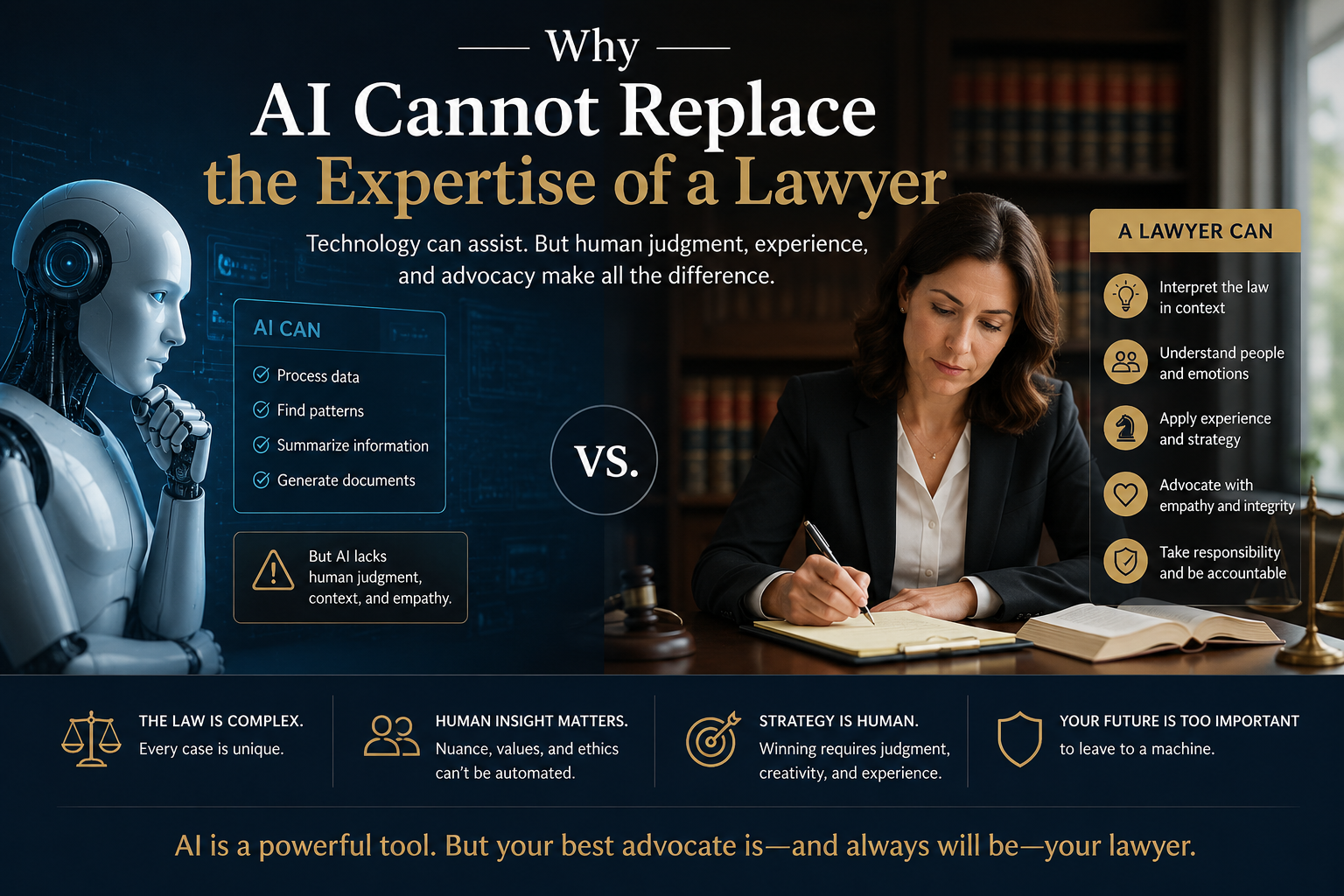
Artificial intelligence (AI) is changing how professionals do their jobs, and legal services are no exception. AI can summarize lengthy documents, conduct case law research, draft contracts, and answer basic legal questions in seconds. With so many things that a lawyer can do being automated, some people wonder whether they still need a lawyer. The short answer is yes.
Although AI can help you conduct legal research faster and automate tasks that would otherwise be tedious, relying on it alone can expose you to costly mistakes. AI doesn't understand the context behind your situation the way an experienced lawyer does. It also cannot provide professional judgment, negotiate with opposing parties on your behalf, or represent you in court.
If you plan to use AI when seeking legal help, make sure you know where its capabilities stop and where a lawyer's expertise is required.
AI Is a Powerful Assistant, Not a Legal Professional
AI is great at quickly finding information. Rather than spending hours manually researching in legal databases, AI-based research tools can find relevant cases, summarize legal precedent, and organize information exponentially faster than any human.
But finding information is only one part of practicing law.
AI does not know what you want to accomplish. It doesn’t know your business or the events leading up to your dispute. It recognizes patterns and predicts the most probable outcome based on the data it's been trained on. Your lawyer analyzes the law, assesses the risks, and crafts a game plan tailored to your specific circumstances.
Think of AI as a superfast legal research assistant. It can pull information in the blink of an eye, but you still need a skilled lawyer to apply it correctly.
AI Doesn't Understand the Facts Behind Your Case
No two legal matters are exactly alike. Imagine two businesses negotiating an equipment lease. But the warranties, payment terms, liability clauses, and government regulations in those leases might be completely different depending on the industry, location, and objectives of each business.
The same is true for two individuals involved in similar legal issues. They could have completely different results based on the facts of their case.
AI can’t pick up on these nuances.
Sure, it can draft a contract based on your instructions. But it won’t ask the probing questions a skilled lawyer would to clarify your needs. It might miss important information you leave out or don’t know to include. It won’t understand if your priorities are conflicting. And it may not know about unusual circumstances that could change the legal advice you receive
When you hire a lawyer, you’re not just paying for paperwork. You’re gaining access to years of schooling, professional experience, and common sense that allows them to spot potential issues before they become costly legal challenges.
AI Can Make Legal Mistakes That Carry Real Consequences
Another danger of depending heavily on general-purpose AI is that it will confidently give you bad information.
AI-written court filings often assert nonexistent case citations and describe legal rules incorrectly. To the untrained eye, these errors may go unnoticed until they cause real damage.
Courts usually don’t care whether you used AI to help draft your court filing. You’ll still be liable for its content. “But the AI wrote it” is not a defense.
It's important to bear this responsibility in mind, especially when you’re submitting documents to a court, signing a legal contract, or taking business action based on legal advice.
Lawyers verify legal authorities, proofread every document they submit, and double-check that their legal arguments are actually supported by law. Review is one of the most important jobs that lawyers do for you. Without professional help, you could end up with incorrect, outdated, or incomplete information.
Lawyers Apply Judgment That AI Cannot Replicate
Law is not just about following rules. It's also about putting those rules into practice for real individuals and circumstances. Legal decisions require weighing interests, reading between the lines, negotiating compromises, and predicting the other party and the judge’s reaction. These decisions require judgment.
AI can draft a contract that “looks right.” But your attorney will know that a warranty provision leaves your company vulnerable to liability or a payment term exposes you to unnecessary risk. Or, perhaps your attorney can read the other side and know when there is room for compromise or when it’s better to negotiate, settle, or fight on in court.
These aren’t robotic decisions based on ones and zeros; they are decisions based on years of experience. Attorneys know how local courts, judges, and government regulations can impact your case. That’s something AI can't replicate.
AI Speeds Up Legal Work Instead of Replacing Lawyers
Instead of replacing lawyers, AI is increasing access to legal services. Lawyers now use AI to do legal research, summarize documents, draft standard agreements, and organize case files. Tasks that used to take hours can now be reduced to minutes.
The attorney will still review the output, check the legal cites, and customize their work for each client, but they won’t be doing as much work digging for information. Instead, they can focus on the legal issue at hand. This means your case could be handled more quickly, certain services could cost less, and you may have better access to legal help.
This newfound efficiency also allows attorneys to handle cases they might have otherwise been forced to reject. Since AI can cut down on the time spent on mundane tasks, lawyers can accept more clients without sacrificing the oversight of a professional.
What AI Means for the Future of Legal Services
AI will keep reshaping how lawyers work, but they won’t be replaced by it. When lawyers don’t have to sift through vast amounts of information to find what they need, they can focus on what they do best: counseling clients, negotiating deals, working out legal issues, and advocating in court.
Judges are also adapting to AI. State and federal jurisdictions are considering or have implemented rules that require attorneys (and in some instances litigants) to disclose when a court filing has been prepared with the assistance of generative AI. These rules reinforce a basic concept: the signer is always responsible for what they sign.
Consider AI a tool, not a professional. It can help you learn about the law, organize your facts, and draft questions to ask your lawyer. Still, when significant matters are at play, such as financial considerations, your business, your home, or your legal rights, it's always best to consult with a lawyer.
Conclusion
AI is transforming legal services. However, it’s not replacing the valuable skills that lawyers offer. Artificial intelligence can conduct legal research, write documents, and automate processes, but it cannot understand the nuances of your case, apply judgment, negotiate with opposing parties, and represent you in court.
The best legal services use AI technology to speed up work, yet your legal issue is handled by a skilled lawyer who uses their experience and judgment to think through your case. Technology automates the mundane tasks, and lawyers provide you with the skilled analysis, strategy, and representation you deserve.